






Accredited by:
Luiggi Caldas • June 17, 2026
Appositive Phrase: Definition, Types, Punctuation Rules, and Examples
If someone asked you to describe your best friend in one sentence, you might say:
"My best friend is really funny."
But what if you could add more detail, without starting a new sentence?
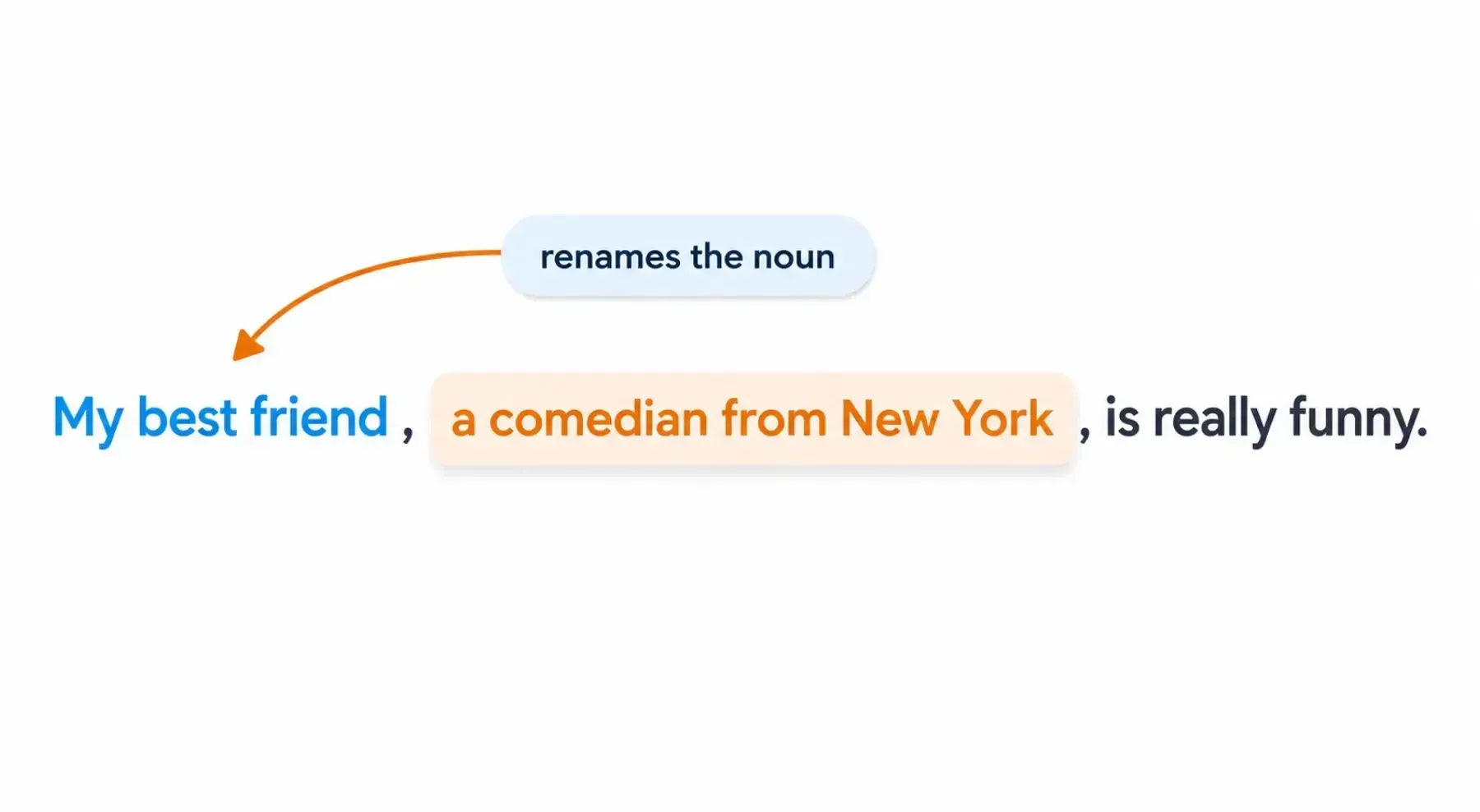
"My best friend, a comedian from New York, is really funny."
The words "a comedian from New York" are an appositive phrase. They rename "my best friend" and give the reader more information, all within the same sentence, without breaking the flow.
Appositive phrases are one of the most useful tools in English grammar. They let you combine information, eliminate choppy sentences, and write with more clarity and style. Whether you're preparing for the TOEFL, writing an academic essay, or simply trying to sound more natural in English, understanding appositives will make your writing stronger.
This guide covers everything from the basic definition to advanced uses, with examples, punctuation rules, common mistakes, and practice exercises.
What Is an Appositive Phrase?
An appositive phrase is a noun phrase that appears next to another noun or pronoun in a sentence to rename it, identify it, or give additional information about it. The word "appositive" comes from the Latin word "apponere," meaning "to put near", and that's exactly what it does: it puts a description near the noun it explains.
The simplest way to understand it: an appositive phrase is a second name for the same thing.
Here are three examples:
"Paris, the capital of France, attracts millions of tourists every year."
, "the capital of France" renames "Paris"
"The novel To Kill a Mockingbird is required reading in many schools."
, "To Kill a Mockingbird" identifies which novel
"My neighbor, a retired pilot, tells the most amazing stories."
, "a retired pilot" gives more information about "my neighbor"
In each case, the appositive phrase could be removed, and the sentence would still be grammatically complete. But the appositive adds valuable detail that makes the sentence richer and more specific.
What Is the Difference Between an Appositive and an Appositive Phrase?
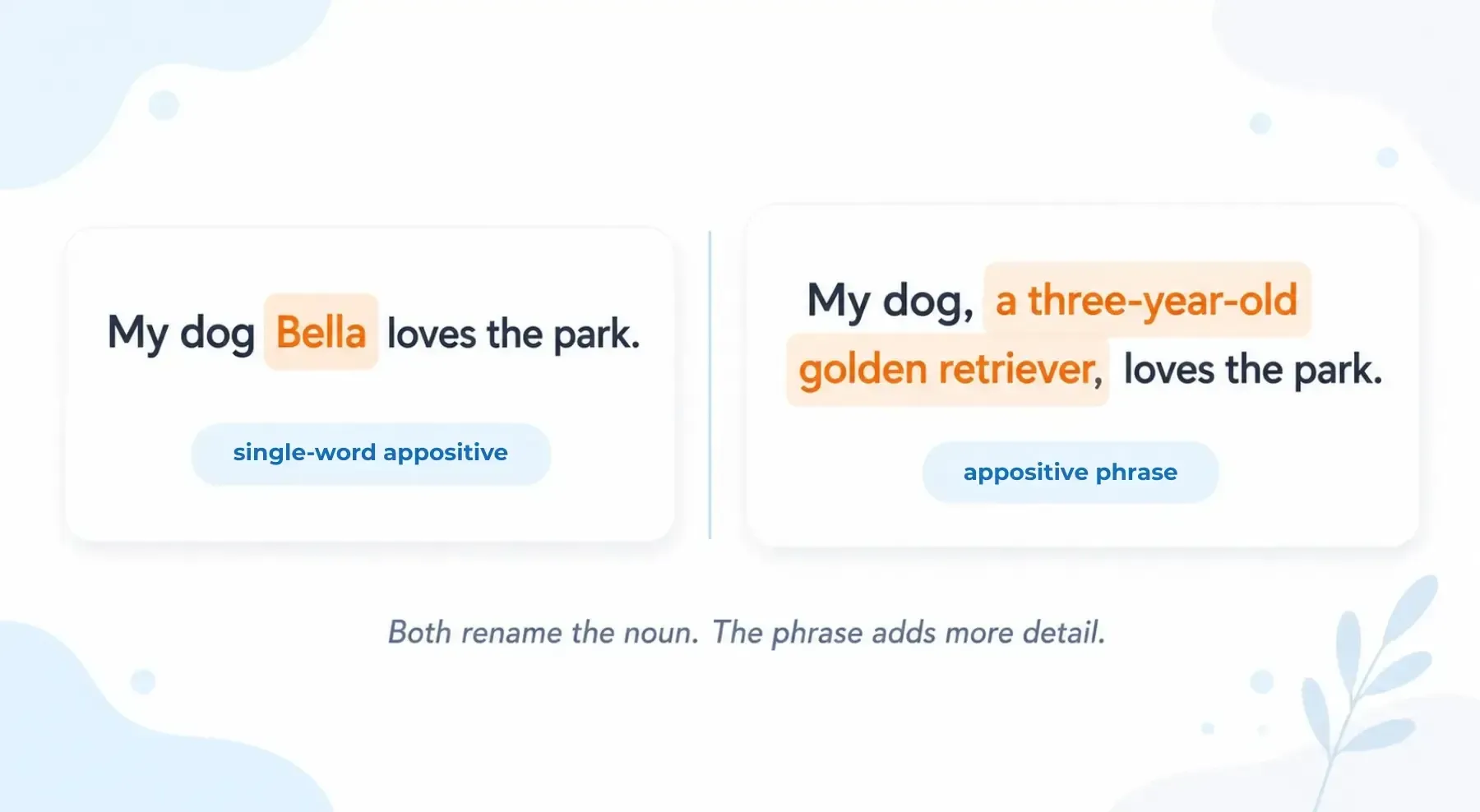
An appositive can be a single word. An appositive phrase includes the appositive word plus any modifiers (adjectives, prepositional phrases, etc.) that go with it.
Single-word appositive:
"My dog Bella loves the park."
, "Bella" is a single-word appositive. It renames "my dog."
Appositive phrase:
"My dog, a three-year-old golden retriever, loves the park."
, "a three-year-old golden retriever" is an appositive phrase. It renames "my dog" with additional detail.
Both are appositives. The phrase version simply carries more information.
What Are the Two Types of Appositive Phrases?
This is the most important distinction in the entire topic, because it determines how you punctuate the sentence. Get this wrong, and the meaning of your sentence changes.
There are two types: restrictive (essential) and nonrestrictive (nonessential).
Restrictive Appositives (Essential, No Commas)
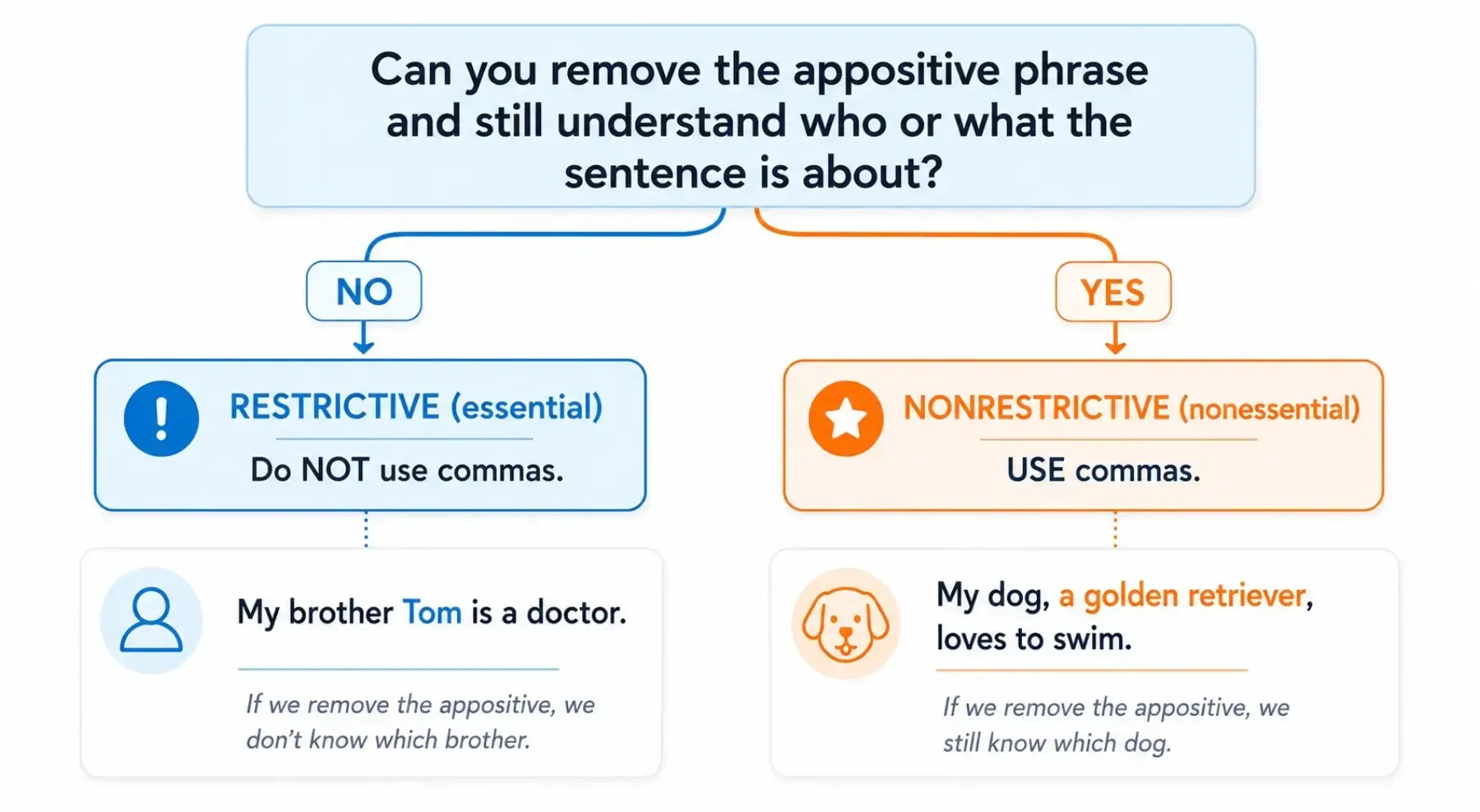
A restrictive appositive provides information that is necessary to identify the noun. Without it, the reader wouldn't know which person, place, or thing you're talking about. Because the information is essential, it is NOT set off by commas.
Examples:
"The movie Titanic won eleven Academy Awards."
If you remove "Titanic," the sentence says: "The movie won eleven Academy Awards." Which movie? The reader doesn't know. The appositive is essential, so no commas.
"My brother Michael lives in California."
If you remove "Michael," the sentence says: "My brother lives in California." If you have more than one brother, the reader doesn't know which one. The name is essential, so no commas.
"The author Jane Austen is known for her social commentary."
Without "Jane Austen," the sentence says: "The author is known for her social commentary." Which author? The appositive is essential, so no commas.
The test: Can you remove the appositive and still know exactly who or what the sentence is about? If NO, the appositive is restrictive. No commas.
Nonrestrictive Appositives (Nonessential, Use Commas)
A nonrestrictive appositive provides extra information that is interesting or helpful but not necessary to identify the noun. The noun is already clearly identified without the appositive. Because the information is nonessential, it IS set off by commas.
Examples:
"Paris, the capital of France, is a popular tourist destination."
We already know which city we're talking about, Paris. "The capital of France" is bonus information. Commas are needed.
"Frédéric Chopin, a Polish composer, was one of the greatest pianists of his era."
We already know who we're talking about, Frédéric Chopin. "A Polish composer" is extra detail. Commas are needed.
"My best friend, a doctor, is coming to visit next week."
If you only have one best friend, the reader already knows who you mean. "A doctor" is nonessential. Commas are needed.
The test: Can you remove the appositive and still know exactly who or what the sentence is about? If YES, the appositive is nonrestrictive. Use commas.
Why Does This Distinction Matter?
Because the presence or absence of commas changes the meaning of your sentence. Consider these two versions:
Version A: "My sister, Charlotte, is a teacher."
, Commas around "Charlotte" = nonrestrictive = you have only ONE sister, and her name is Charlotte.
Version B: "My sister Charlotte is a teacher."
, No commas = restrictive = you have MORE THAN ONE sister, and you're specifying which one.
Same words. Different punctuation. Different meaning.
This is not a minor style choice, it's a factual distinction. Getting it wrong can confuse your reader or communicate something you didn't intend.
More examples of how commas change meaning:
"The CEO, Mark Johnson, resigned yesterday."
= The company has one CEO. His name is Mark Johnson. (nonrestrictive)
"The CEO Mark Johnson resigned yesterday."
= The company may have more than one person with the title CEO, or the writer wants to specify which CEO. (restrictive)
"My car, a red sedan, needs repairs."
= I have one car. It's a red sedan. (nonrestrictive)
"My car the red sedan needs repairs."
= I have more than one car. I'm specifying the red sedan. (restrictive)
How Do You Punctuate Appositive Phrases?
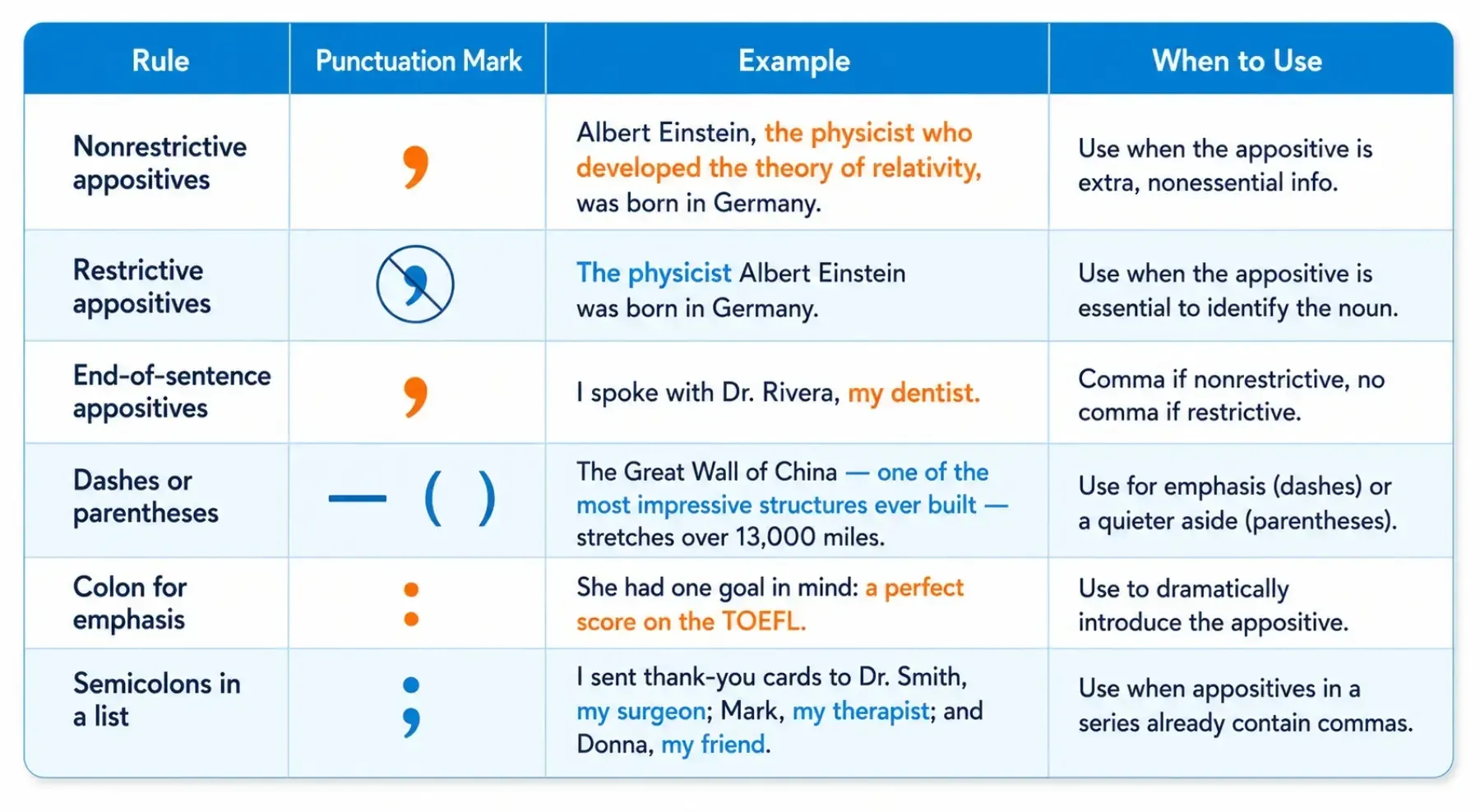
Here are the punctuation rules, summarized with examples:
Rule 1: Use commas for nonrestrictive (nonessential) appositives.
"Albert Einstein, the physicist who developed the theory of relativity, was born in Germany."
The appositive is nonessential, we already know who Albert Einstein is. Commas enclose the phrase.
Rule 2: Do NOT use commas for restrictive (essential) appositives.
"The physicist Albert Einstein was born in Germany."
The appositive is essential, without "Albert Einstein," we don't know which physicist. No commas.
Rule 3: If the appositive comes at the end of a sentence, use a comma before it (nonrestrictive) or no comma (restrictive).
Nonrestrictive: "I spoke with Dr. Rivera, my dentist."
Restrictive: "I spoke with my dentist Dr. Rivera."
Rule 4: You can use dashes or parentheses instead of commas for nonrestrictive appositives, especially for emphasis or to set off a longer phrase.
"The Great Wall of China, one of the most impressive structures ever built, stretches over 13,000 miles."
"The exam (a three-hour written test) will take place on Friday."
Dashes create emphasis. Parentheses create a quieter aside. Commas are neutral. Choose based on the tone you want.
Rule 5: Use a colon to introduce an appositive at the end of an independent clause for emphasis.
"She had one goal in mind: a perfect score on the TOEFL."
The colon signals that what follows is the explanation or identification of what came before.
Rule 6: Use semicolons to separate items in a series when the appositives themselves contain commas.
"I sent thank-you cards to Dr. Smith, my surgeon; Mark, my therapist; and Donna, my friend."
Without semicolons, this list would be a confusing mess of commas.
Where Can You Place an Appositive Phrase in a Sentence?
Appositives usually appear directly after the noun they rename, but they can also appear before or at the end.
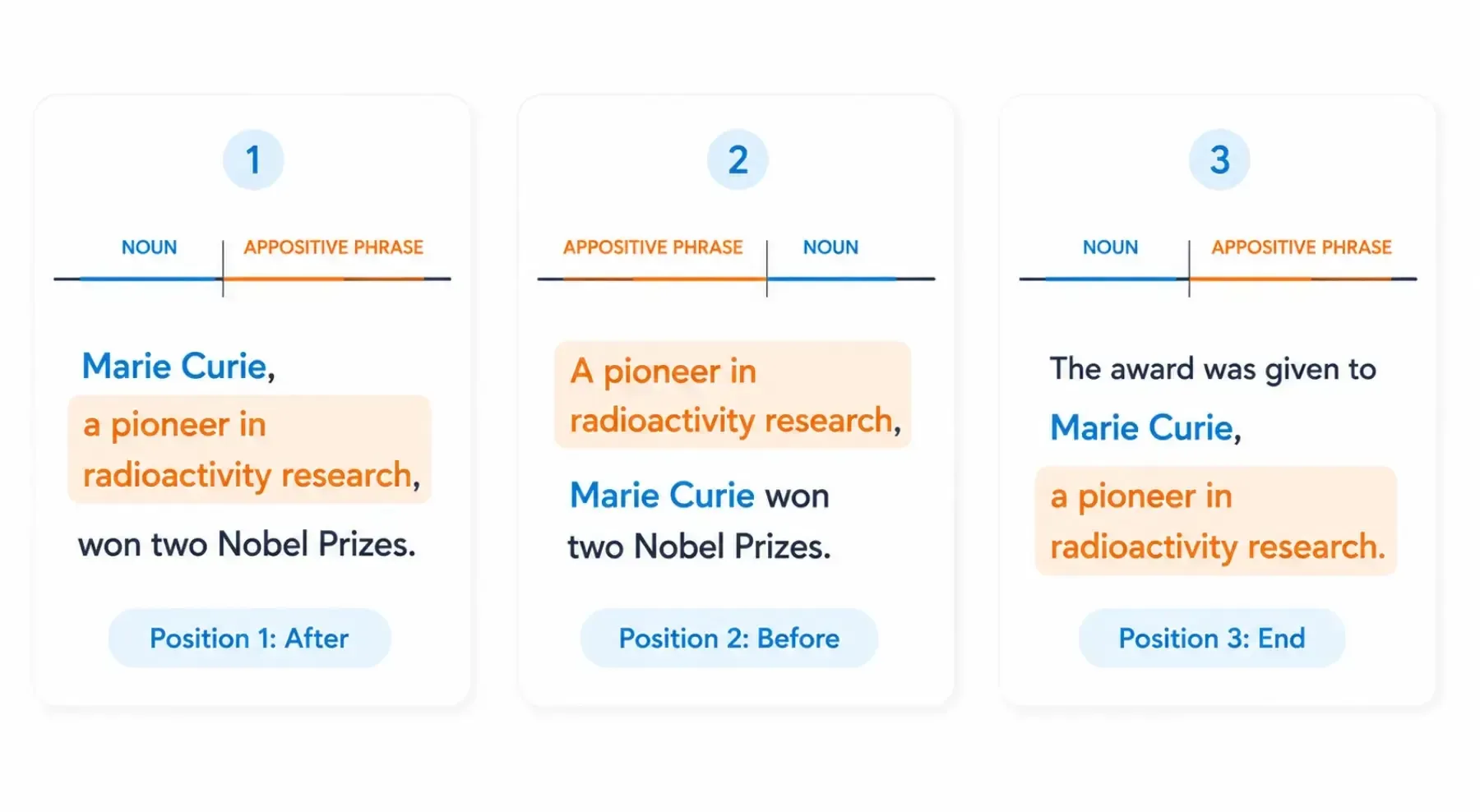
Position 1: After the noun (most common)
"Marie Curie, a pioneer in radioactivity research, won two Nobel Prizes."
Position 2: Before the noun
"A pioneer in radioactivity research, Marie Curie won two Nobel Prizes."
When the appositive comes first, it always takes a comma. This construction adds variety to your writing and is common in academic and literary prose.
Position 3: At the end of the sentence
"The award was given to Marie Curie, a pioneer in radioactivity research."
Position 4: After a pronoun
"She, a pioneer in radioactivity research, changed the course of science."
This is less common but grammatically correct. The appositive renames the pronoun "she."
One important rule: An appositive does NOT function as the subject or object of the sentence. It renames, it does not replace.
Wrong: "Bears, Stephen Colbert's biggest fear, was always at the top of his threat list."
Right: "Bears, Stephen Colbert's biggest fear, were always at the top of his threat list."
The verb "were" agrees with "bears" (the subject), not with "fear" (the appositive). The appositive is always grammatically invisible to the rest of the sentence structure.
What Are the Most Common Mistakes with Appositive Phrases?
These are the errors that writers, including native speakers, make most often.
Mistake 1: Missing the second comma.
Wrong: "John Smith, Jones's rival and number four on the FBI's most-wanted list is caught."
Right: "John Smith, Jones's rival and number four on the FBI's most-wanted list, is caught."
If you open with a comma before a nonrestrictive appositive, you must close with one after it. The appositive is a parenthetical phrase, it needs bookend commas, like parentheses.
Mistake 2: Using commas around a restrictive appositive.
Wrong: "The American poet, Carl Sandburg, wrote about fog."
Right: "The American poet Carl Sandburg wrote about fog."
Putting commas around "Carl Sandburg" implies he is the only American poet. He's not. The name is essential to identify which poet, so no commas.
Mistake 3: Implying the wrong number.
Wrong: "Kate Hudson recalled a memory of giving birth to her son, Bingham." (She has two sons.)
Right: "Kate Hudson recalled a memory of giving birth to her son Bingham."
Adding the comma before "Bingham" implies she has only one son. If she has multiple sons, the name is restrictive (essential to identify which one), so no comma.
Mistake 4: Verb agreement errors.
Wrong: "The documents, a crucial piece of evidence, was submitted to the court."
Right: "The documents, a crucial piece of evidence, were submitted to the court."
The verb agrees with the subject ("documents," plural), not with the appositive ("piece," singular).
Mistake 5: Stacking too many appositives.
Awkward: "Dr. Rivera, a cardiologist, the head of the department, a father of three, spoke at the conference."
Better: "Dr. Rivera, a cardiologist and head of the department, spoke at the conference. He is also a father of three."
Multiple appositives can overload a sentence. When you have more than two, consider splitting into separate sentences.
How Can Appositive Phrases Improve Your Writing?
Appositives are not just a grammar topic, they're a writing tool. Here's how they make your writing better:
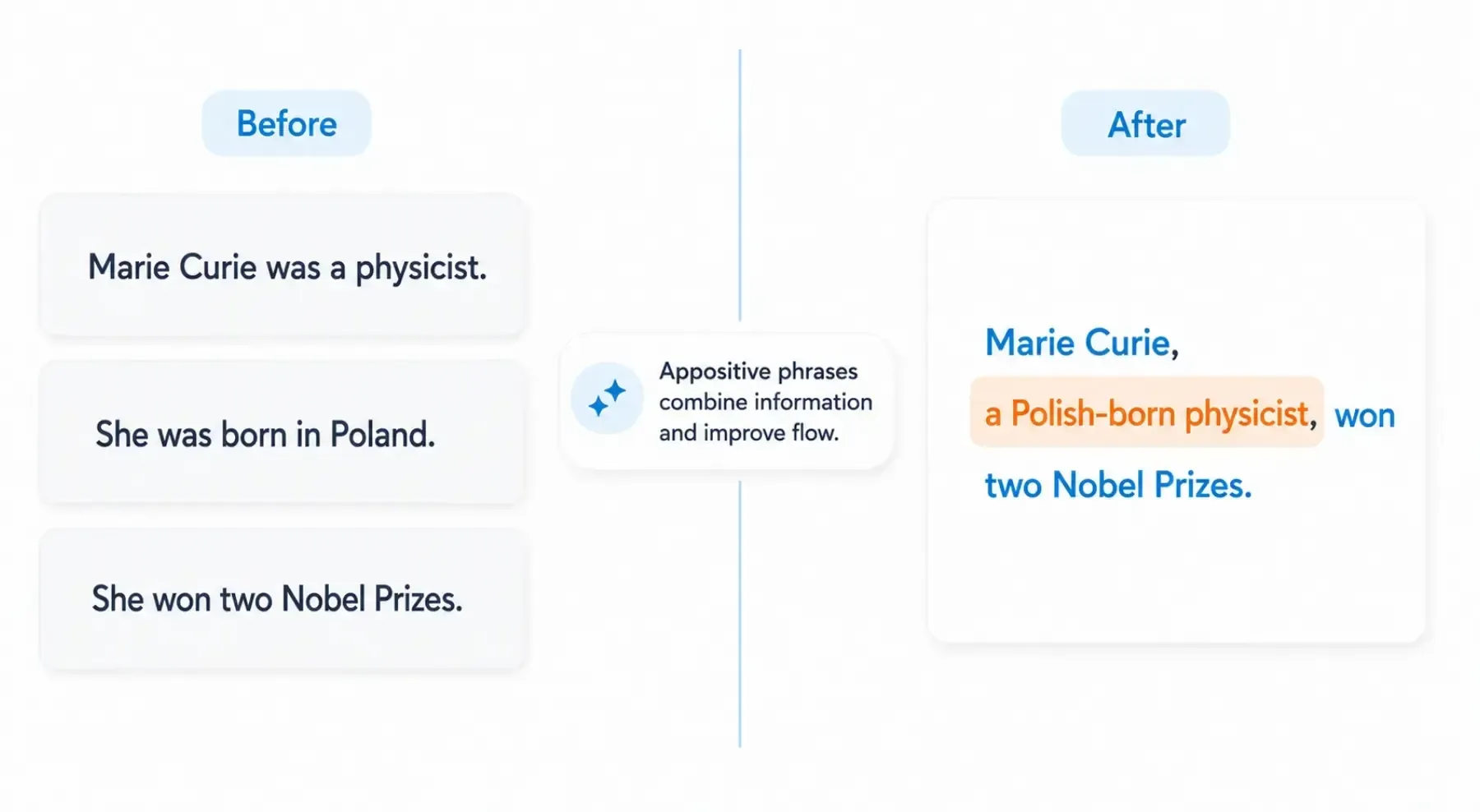
They combine short, choppy sentences.
Before: "Marie Curie was a physicist. She was born in Poland. She won two Nobel Prizes."
After: "Marie Curie, a Polish-born physicist, won two Nobel Prizes."
Three sentences become one. The writing flows better, and the reader absorbs the same information in less time.
They add context without slowing the reader down.
Before: "The TOEFL is a standardized test. It measures English proficiency for non-native speakers. Many universities require it."
After: "The TOEFL, a standardized test measuring English proficiency for non-native speakers, is required by many universities."
They create emphasis.
"She had one dream: a life in the United States."
Using a colon before an appositive at the end of a sentence creates a dramatic pause that emphasizes the appositive.
They define technical terms for the reader.
"The prefrontal cortex, the part of the brain responsible for decision-making, develops fully only in your mid-twenties."
Academic and scientific writing uses appositives constantly to define specialized vocabulary without interrupting the flow of the argument.
Can Appositive Phrases Come in Other Forms?
Yes. While most appositives are noun phrases, there are a few special types worth knowing:
Negative appositives
These use words like "not," "never," or "rather than" to clarify what something is NOT.
"The issue, not the person, is what matters."
"We need action, not words."
"The project requires creativity, rather than resources."
Appositives with "or"
These introduce an alternative name or definition.
"Sodium chloride, or table salt, is essential for human health."
"The conductor, or the person who leads the orchestra, stood at the podium."
This is one of the most common ways to define terms in both academic writing and everyday explanation.
Appositives introduced by expressions like "namely," "that is," "i.e.," or "such as"
"She excels at one skill, namely public speaking."
"The test covers two areas, that is, reading and listening."
These phrases introduce the appositive explicitly, making the relationship between the noun and the appositive crystal clear.
Sentence appositives
A sentence appositive renames or summarizes an entire clause, not just a single noun.
"He passed the exam on his first try, a remarkable achievement considering he had only studied for two weeks."
Here, "a remarkable achievement" renames the entire idea of passing the exam on the first try.
Practice Exercises
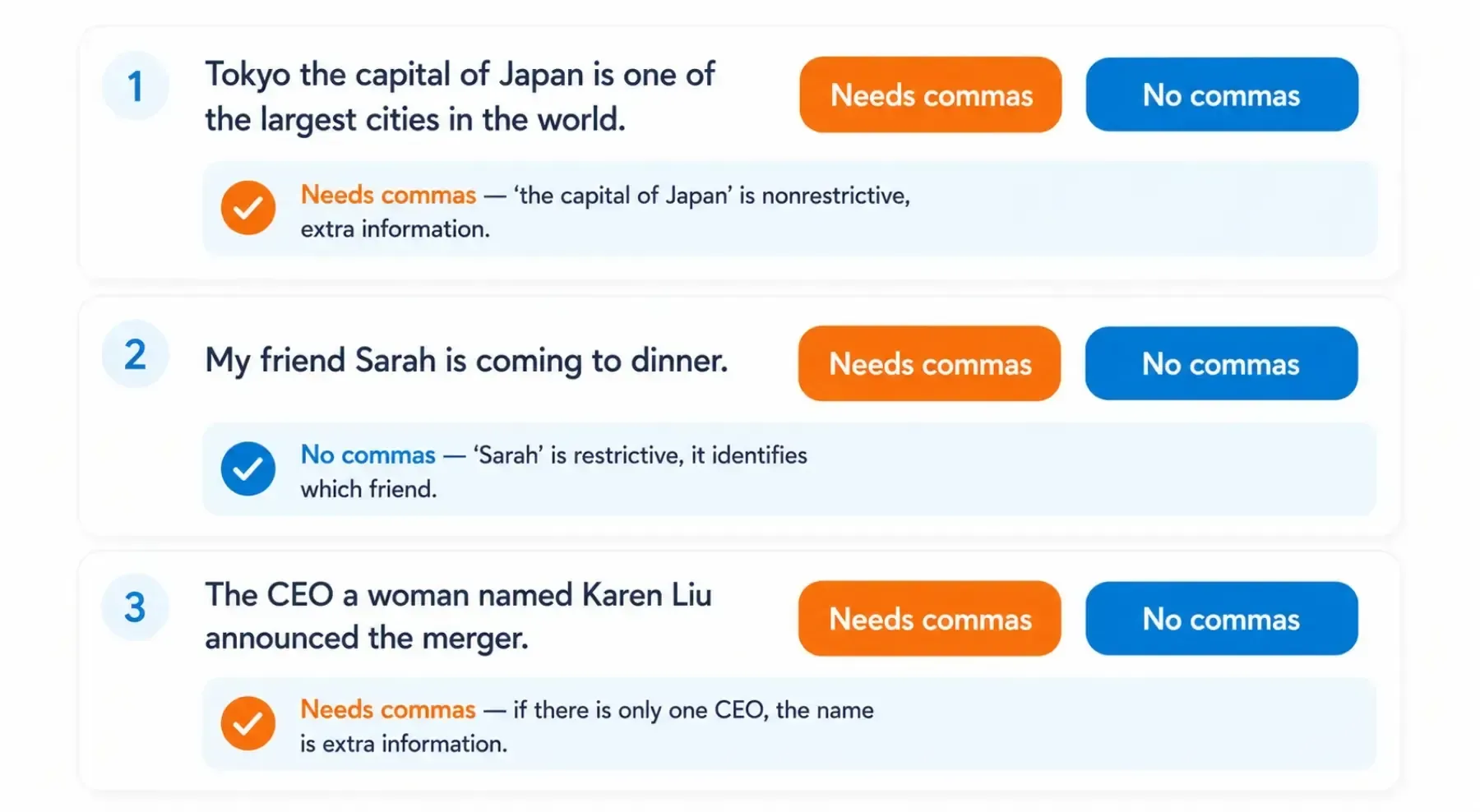
Test your understanding. For each sentence, decide: Is the appositive restrictive or nonrestrictive? Does it need commas?
- The city of Tokyo is one of the largest in the world.
- Tokyo the capital of Japan is one of the largest cities in the world.
- My friend Sarah is coming to dinner.
- Sarah my oldest friend is coming to dinner.
- The book To Kill a Mockingbird is on the reading list.
- Harper Lee's novel To Kill a Mockingbird is on the reading list.
- The CEO announced the merger.
- The CEO a woman named Karen Liu announced the merger.
- My car needs an oil change.
- My car a 2018 Honda Civic needs an oil change.
Answers:
- Restrictive. No commas needed. "Of Tokyo" identifies which city.
- Nonrestrictive. "Tokyo, the capital of Japan, is one of the largest cities in the world." We already know which city, "Tokyo", so "the capital of Japan" is extra information.
- Restrictive. No commas. You likely have more than one friend, so "Sarah" identifies which one.
- Nonrestrictive. "Sarah, my oldest friend, is coming to dinner." We already know it's Sarah. "My oldest friend" is extra information.
- Restrictive. No commas. "To Kill a Mockingbird" tells us which book.
- Restrictive. No commas. "To Kill a Mockingbird" is still needed to identify which of Harper Lee's novels (she wrote two).
- No appositive in this sentence.
- Nonrestrictive. "The CEO, a woman named Karen Liu, announced the merger." If there is only one CEO, the name is extra. Correct version: "The CEO, a woman named Karen Liu, announced the merger."
- No appositive in this sentence.
- Nonrestrictive (if you have one car). "My car, a 2018 Honda Civic, needs an oil change."
Summary: The Key Rules at a Glance
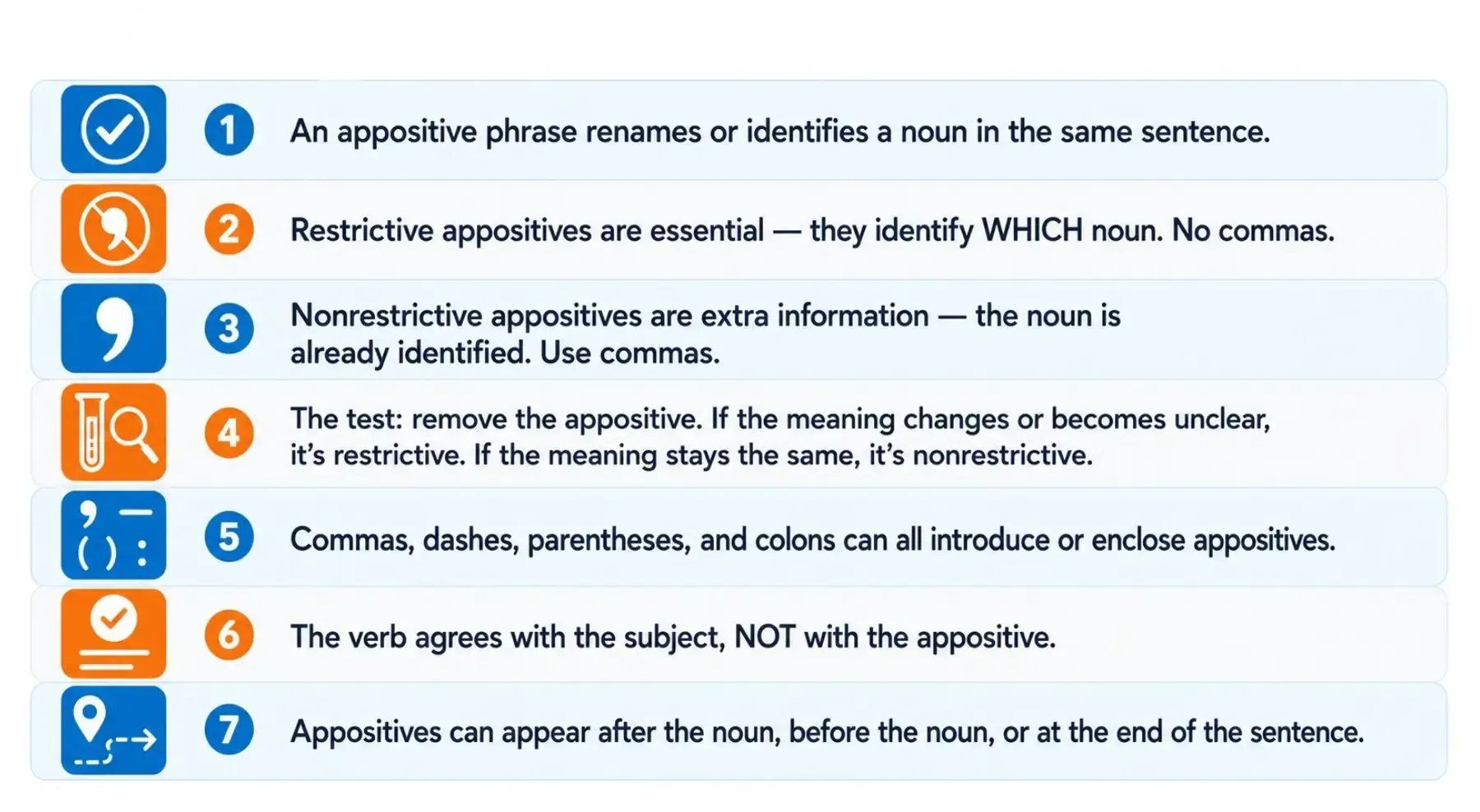
- An appositive phrase renames or identifies a noun in the same sentence.
- Restrictive appositives are essential, they identify WHICH noun. No commas.
- Nonrestrictive appositives are extra information, the noun is already identified. Use commas.
- The test: remove the appositive. If the meaning changes or becomes unclear, it's restrictive. If the meaning stays the same, it's nonrestrictive.
- Commas, dashes, parentheses, and colons can all introduce or enclose appositives.
- The verb agrees with the subject, NOT with the appositive.
- Appositives can appear after the noun, before the noun, or at the end of the sentence.
References
Grammarly. "Appositives and Appositive Phrases, How to Use Them."
https://www.grammarly.com/blog/punctuation-capitalization/appositive/
Scribbr. "Appositive: Examples, Definition & Punctuation."
https://www.scribbr.com/nouns-and-pronouns/appositive/
Grammarist. "Appositive Phrases and How to Use Them in a Sentence."
https://grammarist.com/grammar/appositives/
Thesaurus.com. "What Are Appositives & Appositive Phrases? Types and Examples."
https://www.thesaurus.com/articles/appositive-phrases
Daily Writing Tips. "5 Appositive Phrases with Punctuation Problems."
https://www.dailywritingtips.com/appositive-phrases-punctuation-problems/
Daily Writing Tips. "3 Appositive Errors."
https://www.dailywritingtips.com/3-appositive-errors/
Proofed. "Grammar Tips: Appositives and Appositive Phrases."
https://proofed.com/writing-tips/grammar-tips-appositives-and-appositive-phrases/
Proof-Reading-Service.com. "How to Use Appositive Words, Phrases & Clauses in English."
https://www.proof-reading-service.com/blogs/academic-publishing/using-appositive-words-phrases-and-clauses-in-english
Let's Get Published. "Are You Making This Common Mistake with Appositives?"
https://letsgetpublished.com/mistake-with-appositives/
This guide was published by Lingua Language Center, teaching English and foreign languages in South Florida since 1998. For more free English resources, visit lingua.edu/blog.