

Luiggi Caldas • April 20, 2026

50 Commonly Misspelled Words in English (and How to Get Them Right)

50 Commonly Misspelled Words in English (and How to Get Them Right)


English spelling doesn't always make sense. The same sound can be written five different ways, silent letters appear without warning, and rules like "I before E, except after C" have so many exceptions that the rule itself barely holds up.

The result? Even experienced writers — native speakers included — misspell words every day. And for anyone learning English as a second language, spelling can feel like an obstacle course designed by someone who enjoys watching people trip.

But here's the good news: most spelling mistakes happen with the same words, over and over. Learn to spell these 50 words correctly, and you'll eliminate the vast majority of errors in your writing — whether you're drafting an email, writing an essay, preparing for the TOEFL, or simply texting a friend.

At Lingua Language Center, we've been teaching English in South Florida for over 27 years. These are the words our instructors see misspelled most often — along with the reasons they're tricky and simple tricks to remember them.


Why Is English Spelling So Difficult?

Before we get to the list, it helps to understand why English spelling is uniquely challenging. There are a few key reasons:

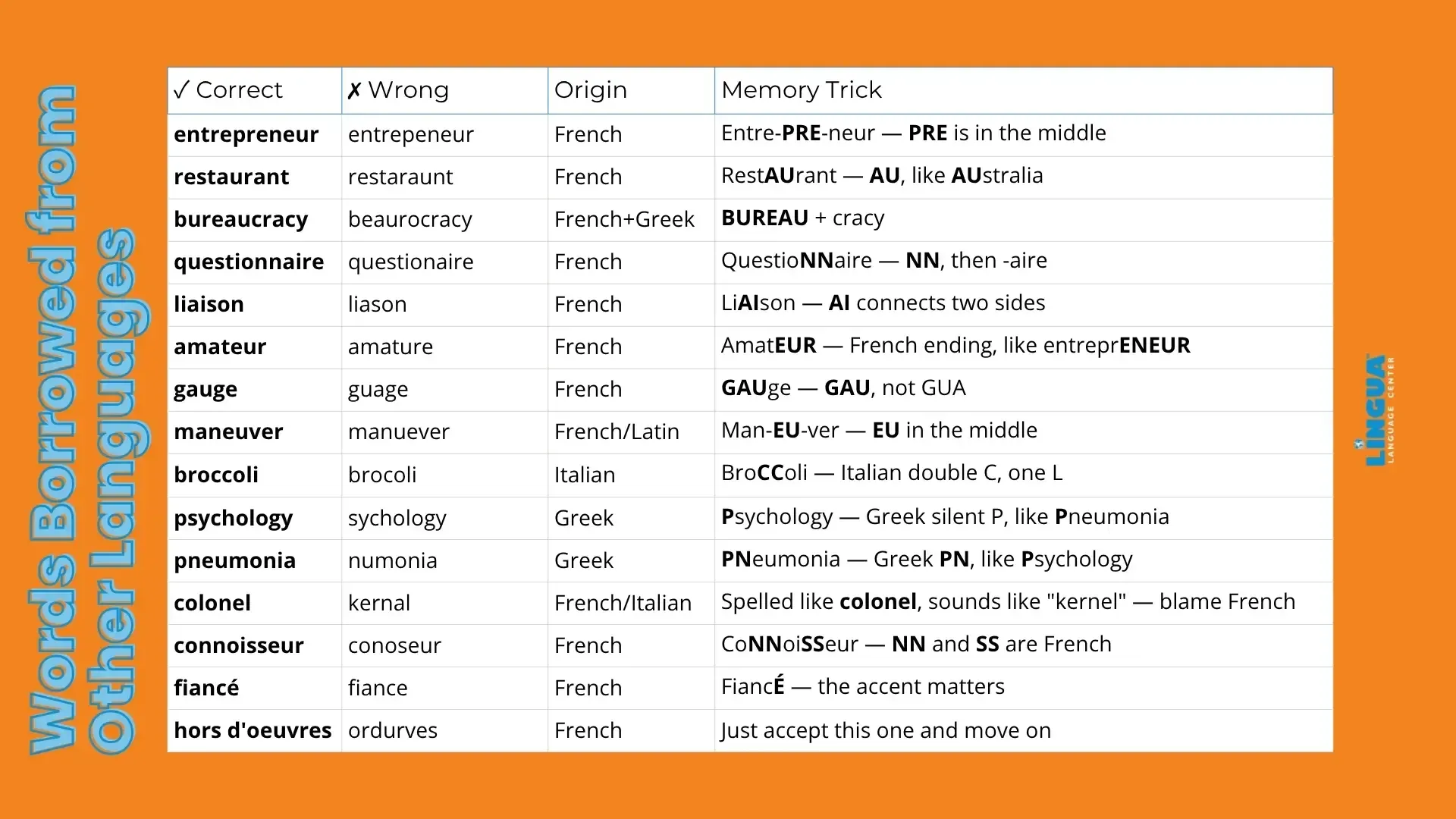
English borrows from everywhere. English has absorbed vocabulary from Latin, French, Greek, German, Arabic, Hindi, and dozens of other languages over centuries. Each source language brought its own spelling conventions, and English kept many of them. That's why "psychology" starts with a silent P (from Greek), "restaurant" has a French spelling pattern, and "schedule" can be pronounced two different ways depending on whether you follow British or American convention.

Vowel sounds are inconsistent. The letter "A" makes different sounds in "cat," "cake," "car," and "about." Multiply that across all five vowels and you begin to see the problem. Linguists call the short, unclear vowel sound (like the "a" in "about") a schwa — and it's the single biggest reason people misspell words, because you can't hear which vowel actually belongs there.

Silent letters are everywhere. "Knife," "psychology," "Wednesday," "receipt" — English is full of letters that exist in the spelling but not in the pronunciation. Many of these silent letters made sense historically (they were once pronounced) but stuck around in the spelling long after the pronunciation changed.

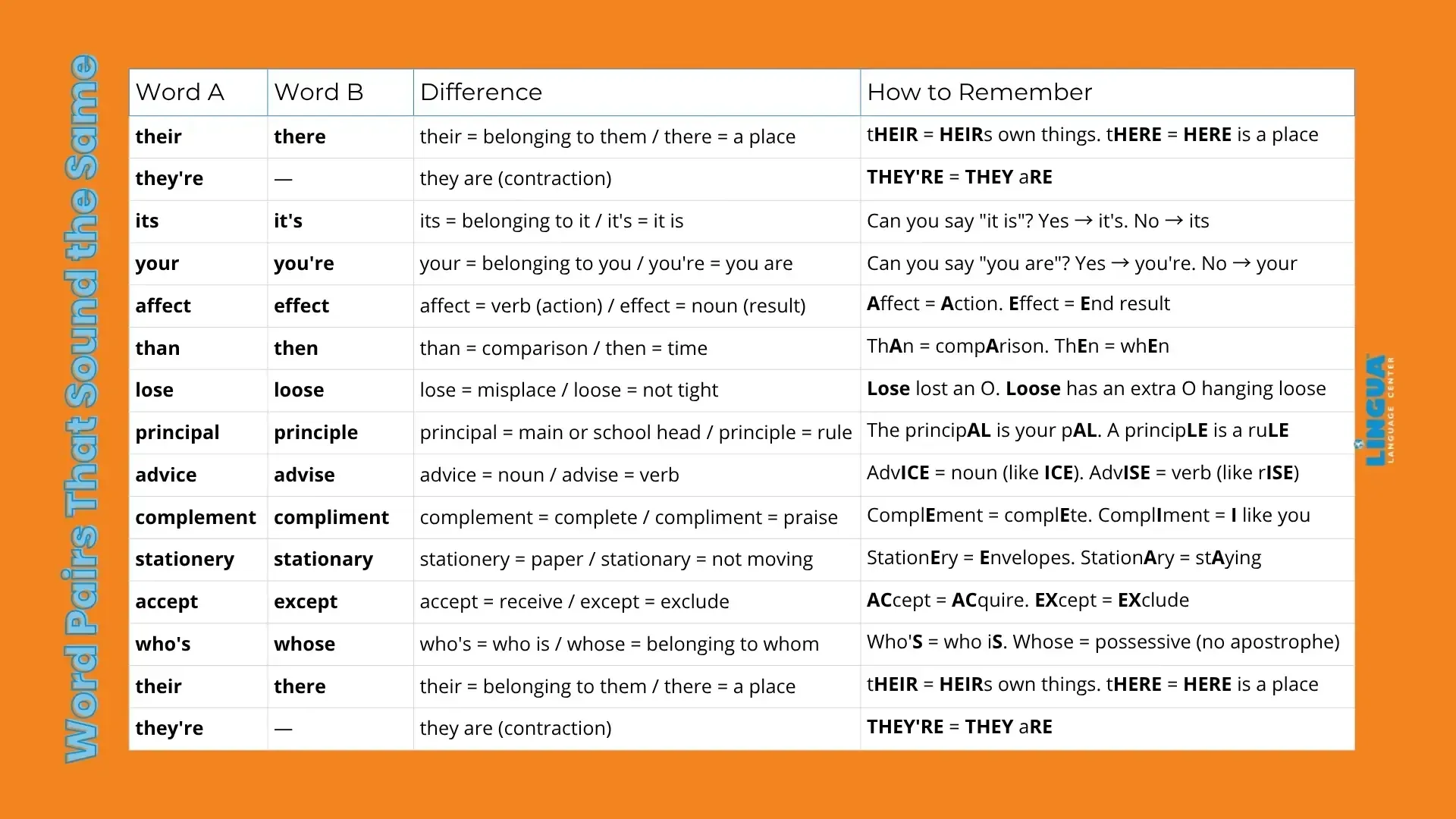
Homophones create confusion. Words like "their/there/they're," "your/you're," and "its/it's" sound identical but mean different things. These aren't traditional spelling errors — they're usage errors — but they're among the most common mistakes in English writing.

Understanding these patterns won't eliminate every mistake, but it makes the mistakes feel less random. English spelling is difficult because the language has a complicated history — not because you're a bad speller.


The 50 Most Commonly Misspelled Words

Here are 50 words that trip up writers of all levels — organized by the type of mistake they cause.

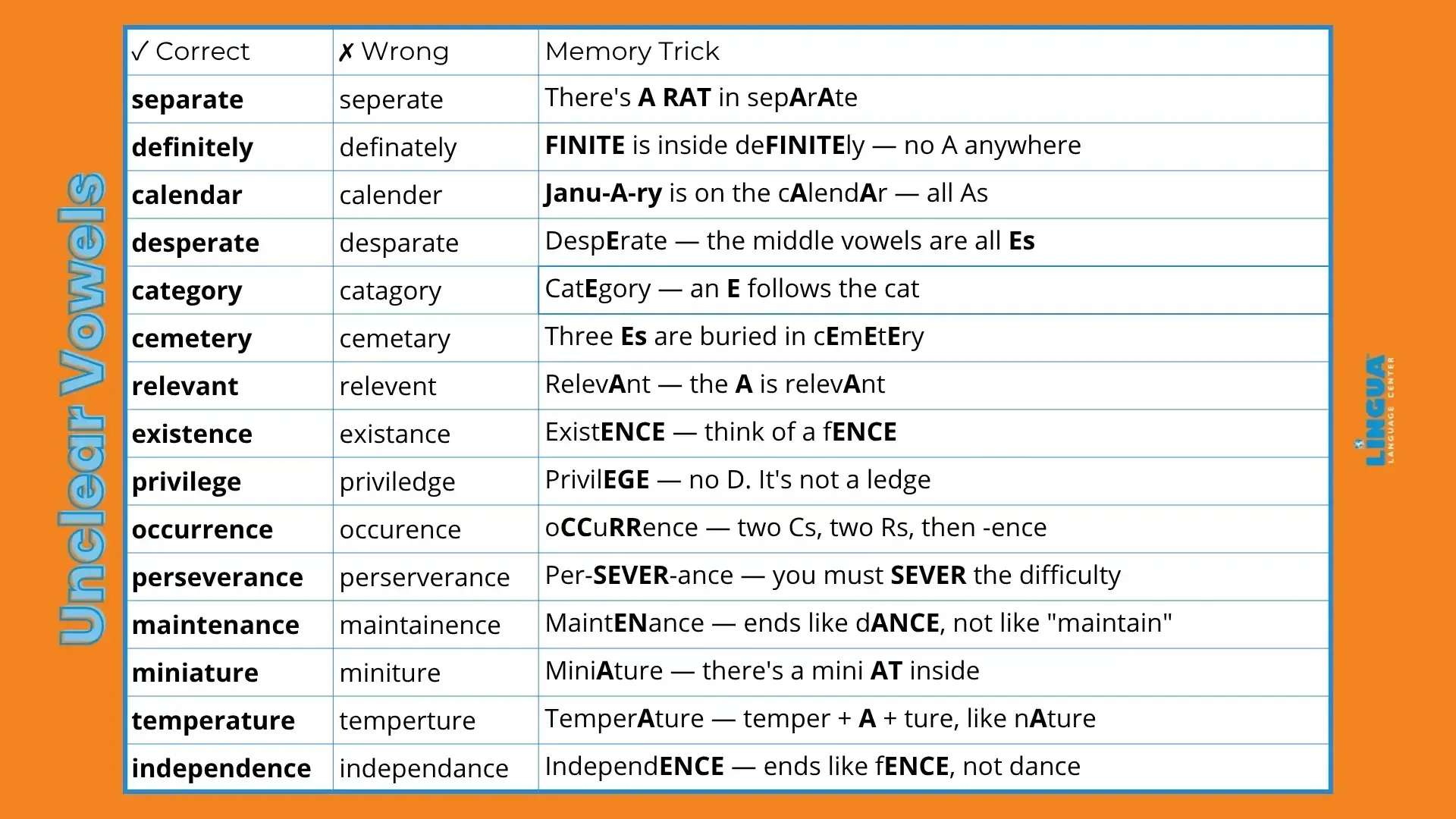
Words with Tricky Vowels

These words are hard because the vowel sound is unclear when spoken. You hear a vague "uh" sound and have to guess which vowel goes there.

1. Separate — not "seperate." The middle vowel is A, not E. Trick: There's A RAT in sepARAte.

2. Definitely — not "definately." There's no A in this word. Trick: It comes from "finite" — definITEly.

3. Occurrence — not "occurence." Double C, double R, then -ence. Trick: Two Cs, two Rs, that's what ocCuRRence prefers.

4. Calendar — not "calender." The last vowel is A. Trick: JanuAry is on the cAlendAr.

5. Relevant — not "relevent." The last vowel before -nt is A.

6. Privilege — not "priviledge." No D, and the ending is -lege, not -ledge.

7. Category — not "catagory." The second vowel is E.

8. Cemetery — not "cemetary." All three vowels are E. Trick: Three Es, no As — cEmEtEry.

9. Desperate — not "desparate." The third vowel is E, not A.

10. Existence — not "existance." It ends in -ence, not -ance.


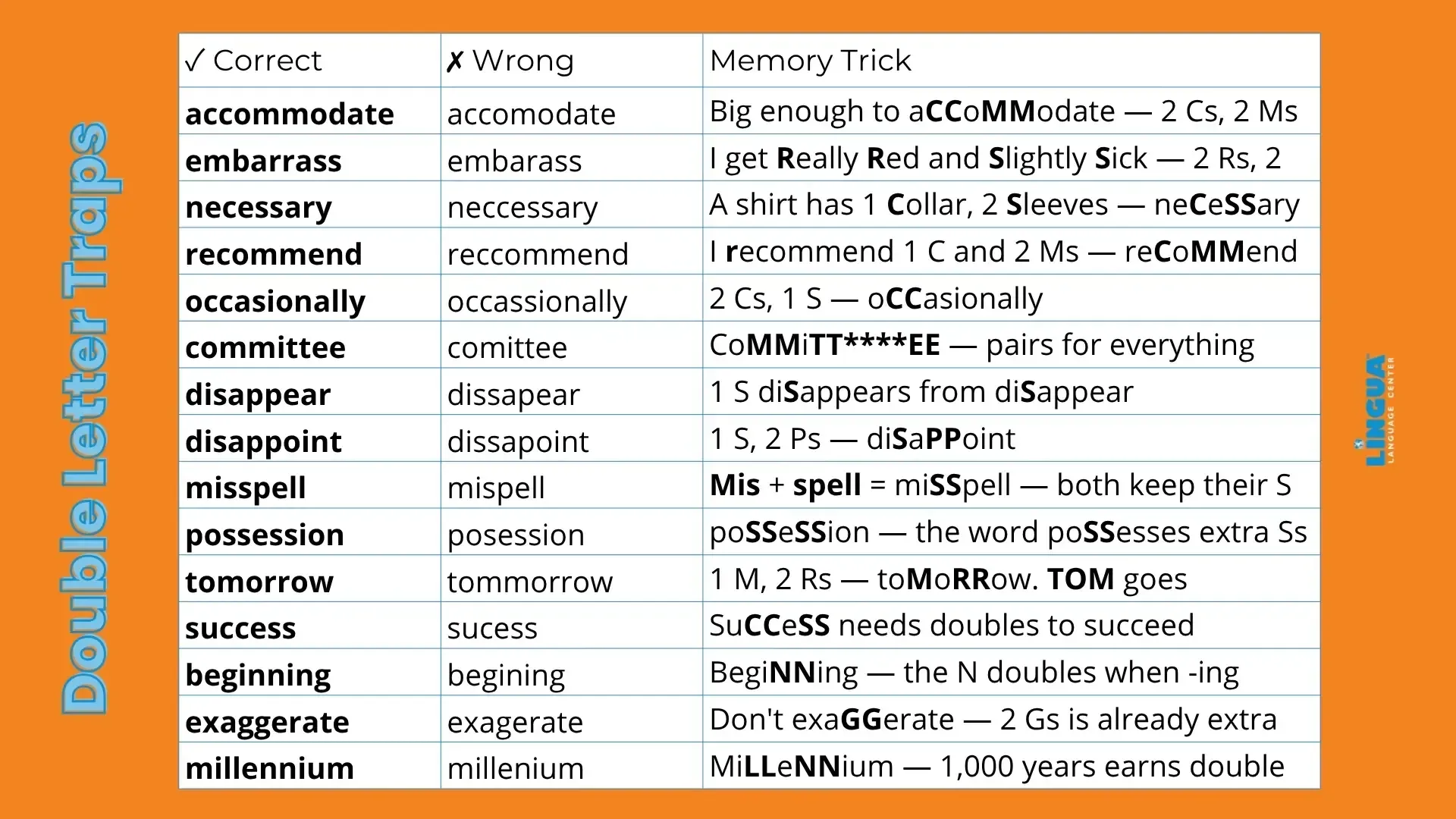
Words with Double Letters

Should it be one L or two? One S or two? These words cause confusion because the doubling pattern isn't obvious from pronunciation.

11. Accommodate — not "accomodate." Double C and double M. Trick: It's big enough to aCCoMModate two Cs and two Ms.

12. Embarrass — not "embarass." Double R and double S.

13. Necessary — not "neccessary." One C, two Ss. Trick: A shirt has one Collar and two Sleeves — neCeSSary.

14. Recommend — not "reccommend." One C, two Ms.

15. Occasionally — not "occassionally." Two Cs, one S.

16. Committee — not "comittee." Double M, double T, double E.

17. Disappear — not "dissapear." One S, two Ps.

18. Disappoint — not "dissapoint." One S, two Ps.

19. Tomorrow — not "tommorrow." One M, two Rs.

20. Possession — not "posession." Two Ss in the middle, two Ss at the end.


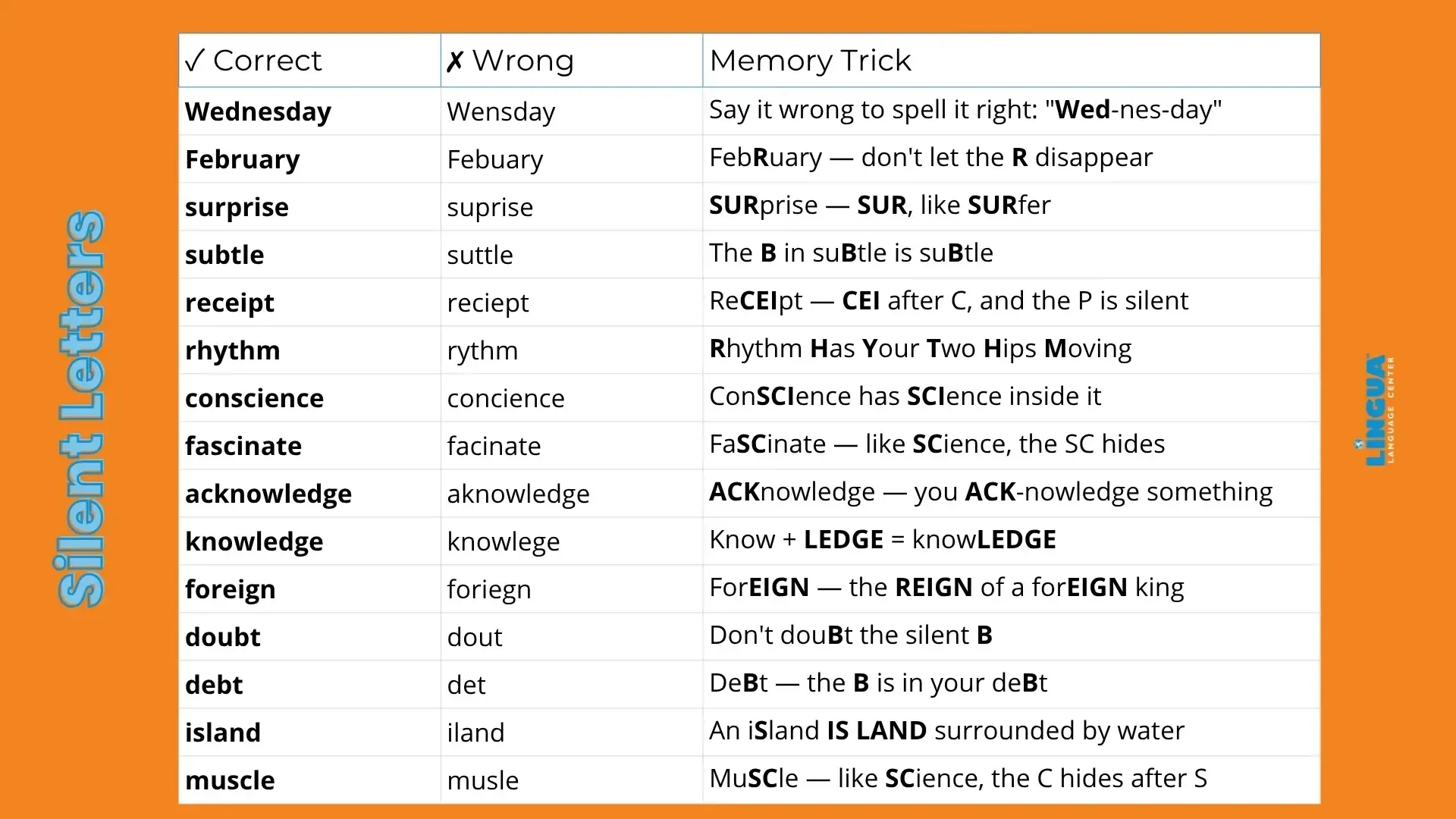
Words with Silent or Unexpected Letters

These words contain letters you can't hear — or letters where you don't expect them.

21. Acknowledge — not "aknowledge." The C is silent but present.

22. Acquaintance — not "aquaintance." Don't forget the C after A.

23. Conscience — not "concience." SCI is the correct pattern, as in "science."

24. Fascinate — not "facinate." There's a silent C after S.

25. Wednesday — not "Wensday." The D is silent but must be written. Trick: Pronounce it "Wed-nes-day" in your head when spelling.

26. February — not "Febuary." The first R is often dropped in speech but required in writing.

27. Surprise — not "suprise." There's an R after the first U.

28. Receipt — not "reciept." The P is silent, and it follows the "E before I after C" rule.

29. Rhythm — not "rythm" or "rhythym." No vowel at all — just consonants and Y.

30. Subtle — not "suttle." The B is silent.


Words People Confuse with Similar Words

These aren't always misspelled — they're misused. But in writing, using the wrong form looks like a spelling error.

31. Their / There / They're — "Their" = belonging to them. "There" = a place. "They're" = they are.

32. Your / You're — "Your" = belonging to you. "You're" = you are.

33. Its / It's — "Its" = belonging to it. "It's" = it is or it has. Trick: If you can replace it with "it is," use the apostrophe. If not, don't.

34. Affect / Effect — "Affect" is usually a verb (to affect something). "Effect" is usually a noun (an effect). Trick: Affect = Action, Effect = End result.

35. Than / Then — "Than" is for comparison (bigger than). "Then" is for time (and then we left).

36. Lose / Loose — "Lose" means to not win or to misplace something. "Loose" means not tight.

37. Principal / Principle — "Principal" = main or head of a school. "Principle" = a rule or belief. Trick: The principAL is your pAL.

38. Advice / Advise — "Advice" is the noun (give advice). "Advise" is the verb (I advise you).

39. Complement / Compliment — "Complement" = to complete. "Compliment" = to praise.

40. Stationery / Stationary — "Stationery" = paper and pens. "Stationary" = not moving. Trick: StationEry is for Envelopes.


Words That Just Look Wrong

These are the words that make you second-guess yourself every time, even if you've spelled them correctly.

41. Entrepreneur — borrowed from French, with all its French spelling quirks.

42. Bureaucracy — another French import. Trick: BUREAU + CRACY.

43. Maintenance — not "maintainence." It comes from "maintain" but changes the ending.

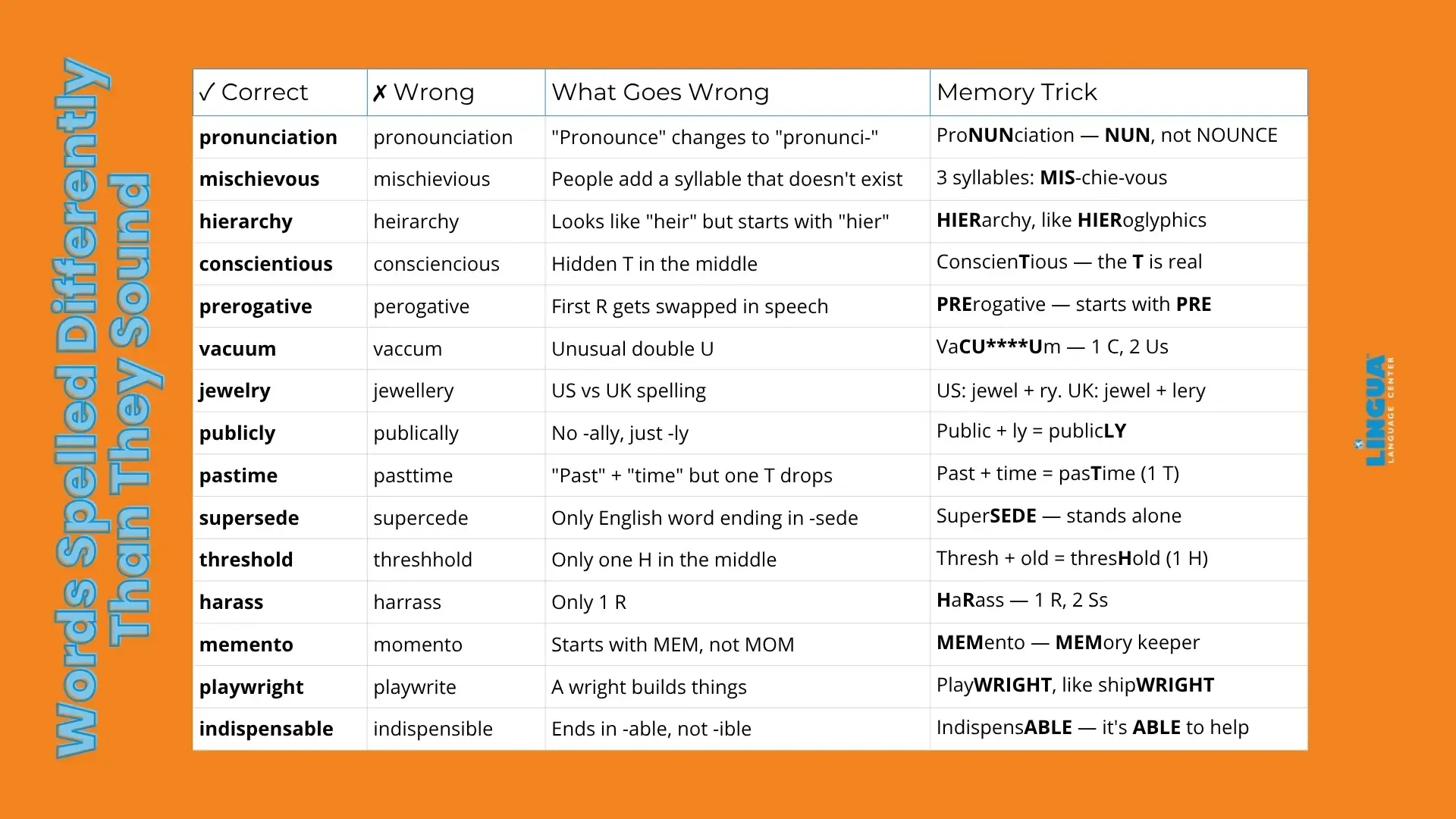
44. Pronunciation — not "pronounciation." There's no "pronounce" inside this word.

45. Questionnaire — double N and ends in -aire (French pattern).

46. Restaurant — not "restaraunt." Trick: Remember the French AU pattern.

47. Vacuum — not "vaccum." One C, two Us.

48. Hierarchy — not "heirarchy." It starts with HIER, not HEIR.

49. Mischievous — not "mischievious." Only three syllables: mis-chie-vous.

50. Conscientious — not "consciencious." The T in the middle is real and necessary.


5 Rules That Actually Help

English spelling rules are famously unreliable — but a few of them work often enough to be worth remembering:

Rule 1: I before E, except after C — works for "believe," "receive," "achieve," "ceiling." Exceptions exist ("weird," "seize," "science"), but the rule covers the majority of cases.

Rule 2: Drop the silent E before adding a suffix that starts with a vowel — "make" becomes "making," "hope" becomes "hoping." But keep the E when the suffix starts with a consonant: "hopeful," "movement."

Rule 3: Change Y to I before adding a suffix — "happy" becomes "happiness," "carry" becomes "carried." Exception: keep the Y before "-ing" ("carrying").

Rule 4: Double the final consonant when adding -ed or -ing to a short word ending in consonant-vowel-consonant — "stop" becomes "stopped," "run" becomes "running." This only applies when the final syllable is stressed.

Rule 5: For plurals, add -es after S, X, Z, CH, or SH — "boxes," "watches," "dishes." For most other words, just add -s.

These five rules won't cover every situation, but they'll help you make the right call more often than guessing.


How to Improve Your Spelling Over Time

Memorizing a list helps, but real spelling improvement comes from consistent practice in context. Here are approaches that actually work:

Read in English daily. Your brain absorbs spelling patterns through exposure. The more you see a word spelled correctly, the more natural it becomes. News articles, books, and well-edited websites are all good sources.

Write by hand. Research suggests that handwriting activates different memory pathways than typing. When you write a word by hand, you're more likely to remember its spelling.

Keep a personal list. When you misspell a word, add it to a list. Review it weekly. Over time, your list gets shorter — and so do your mistakes.

Learn word roots. Many English words share roots from Latin, Greek, or French. Understanding roots helps you predict spelling patterns. For example, knowing that "-tion" comes from Latin helps you spell "accommodation," "pronunciation," and "information" correctly.

Study with a teacher. A qualified instructor can identify your personal spelling patterns — the kinds of mistakes you make most often — and give you targeted practice that a list or app can't provide.


Improve Your English at Lingua Language Center

Spelling is just one piece of the puzzle. At Lingua Language Center, our English programs cover reading, writing, speaking, and listening in an integrated, communicative approach designed for real results.

Whether you're preparing for the TOEFL, studying English for professional advancement, or building foundational skills as a beginner, our ACCET-accredited programs give you the structure, expert instruction, and daily practice you need to improve — with in-person classes in Miami (Doral), Fort Lauderdale, and Weston, or online through our interactive Virtual Campus.

Want to strengthen your English? Contact us or apply now to get started.


Frequently Asked Questions

What are the most commonly misspelled words in English? Among the most frequently misspelled words are "accommodate," "separate," "definitely," "necessary," "embarrass," "occurrence," and "receive." These words are tricky because of double letters, unclear vowel sounds, or silent letters.

Why is English spelling so hard? English has borrowed vocabulary from Latin, French, Greek, German, and many other languages, each bringing different spelling conventions. Combined with inconsistent vowel sounds, silent letters, and homophones, spelling in English is unusually challenging — even for native speakers.

How can I improve my English spelling? The most effective strategies include reading in English daily, keeping a personal list of words you misspell, writing by hand, learning word roots, and studying with a qualified instructor who can identify your specific patterns of error.

What is the "I before E" rule? The traditional rule is "I before E, except after C" — so "believe" but "receive." However, there are notable exceptions like "weird," "seize," and "science," so the rule should be treated as a guideline rather than an absolute.