



Accredited by:
Luiggi Caldas • April 22, 2026
The Verb "To Be" in English: Complete Guide With Examples, Common Mistakes, and Practice
The verb "to be" is the most used verb in the English language — and the most irregular. It's the first verb you learn and the last one you fully master, because it shows up in almost every sentence and breaks almost every rule.
If you can use "to be" correctly and naturally, you can introduce yourself, describe people and places, talk about your feelings, ask questions, form other tenses, and hold basic conversations. If you can't, every sentence you say will sound unnatural — even if the rest of your grammar is perfect.
This guide covers everything you need to know about the verb "to be" — from the basics that beginners need to the subtle mistakes that even intermediate learners keep making. It's written for real English learners, not grammar textbooks.
What Does "To Be" Mean?
"To be" is a verb that expresses a state of existence, identity, or condition. It doesn't describe an action (like "run" or "eat"). Instead, it describes what something is, was, or will be.
You use "to be" when you want to say:
- Who you are: I am Maria. He is a doctor.
- Where you are: We are in Fort Lauderdale. She is at home.
- How you feel: I am tired. They are happy.
- What something is like: The weather is beautiful. The test was difficult.
- Your age: I am 25 years old. She is 30.
- Your nationality: He is Brazilian. We are Colombian.
"To be" is also used as a helping verb to form other tenses — like the present continuous ("I am studying") and the passive voice ("The letter was written"). But we'll start with the simple forms.
"To Be" in the Present Tense
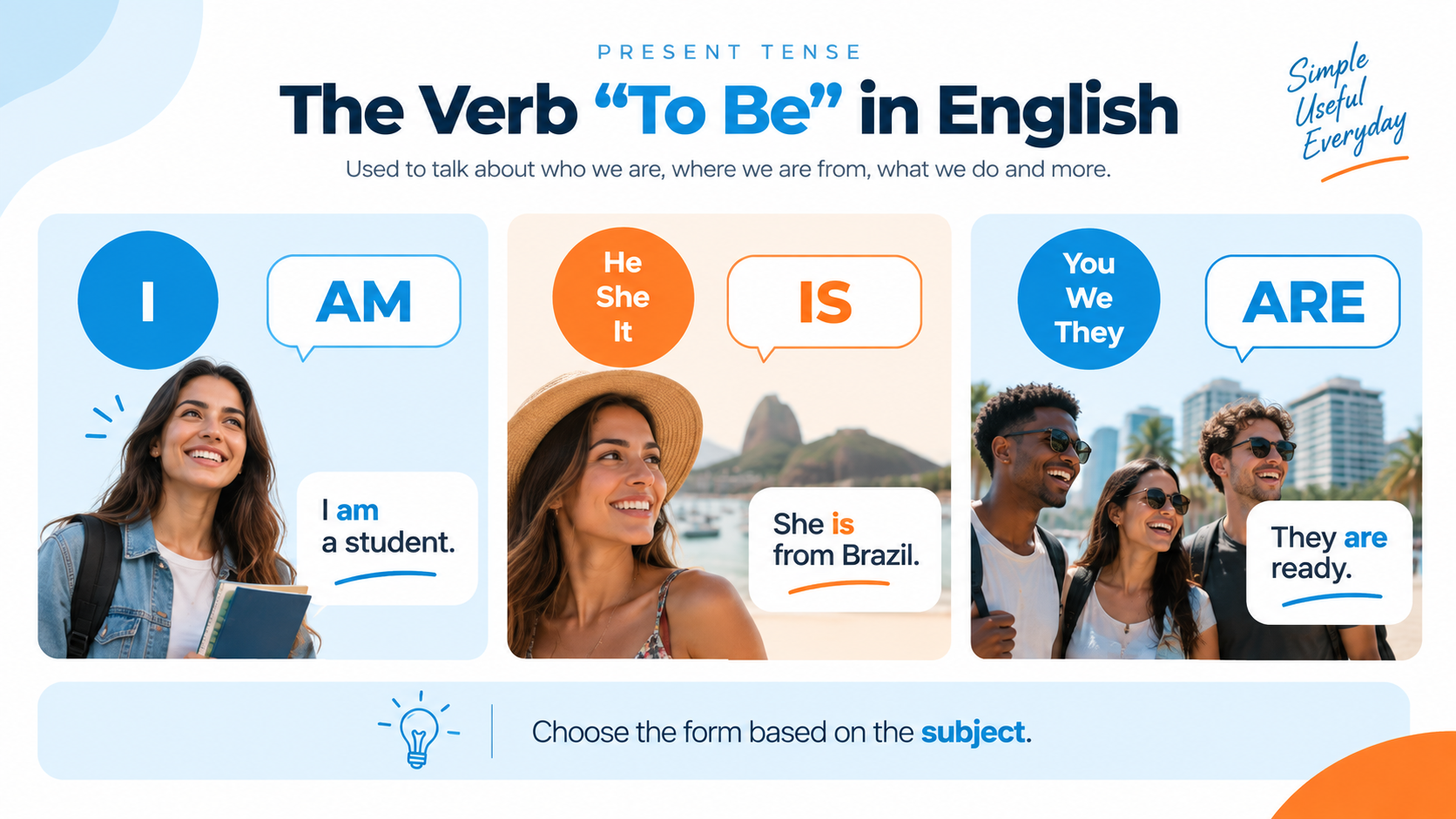
The present tense of "to be" has three forms: am, is, are. Which one you use depends on the subject.
| Subject | Verb | Example |
|---|---|---|
| i | am | I am a student at Lingua Language Center. |
| He / She / It | is | She is from Brazil. It is hot today. |
| You / We / They | are | You are in my class. We are in Fort Lauderdale. They are ready. |
Contractions (How Native Speakers Actually Talk)
In everyday speech and informal writing, native speakers almost always use contractions. If you want to sound natural, you should too.
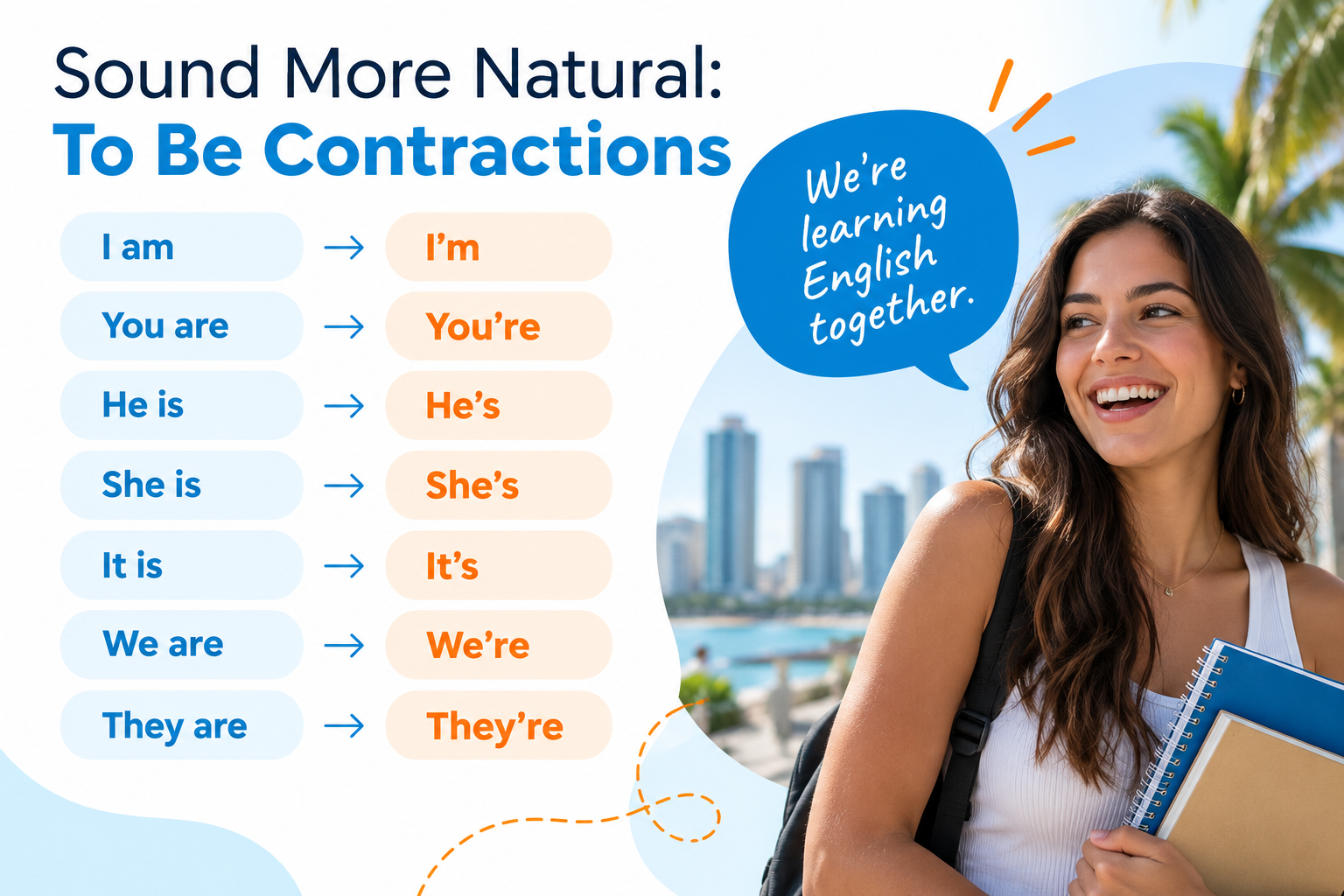
| Full Form | Contraction | Example |
|---|---|---|
| I am | I'm | I'm studying English in Doral. |
| He is | He's | He's my classmate. |
| She is | She's | She's from Colombia. |
| It is | It's | It's a beautiful day in Weston. |
| You are | You're | You're doing great! |
| We are | We're | We're learning English together. |
| They are | They're | They're at the Fort Lauderdale campus. |
Negative Form
To make "to be" negative, add not after the verb.
| Full Form | Contraction | Example |
|---|---|---|
| I am not | I'm not | I'm not tired. |
| He is not | He isn't / He's not | He isn't late. |
| She is not | She isn't / She's not | She isn't from Miami. |
| It is not | It isn't / It's not | It isn't cold today. |
| You are not | You aren't / You're not | You aren't wrong. |
| We are not | We aren't / We're not | We aren't in class right now. |
| They are not | They aren't / They're not | They aren't ready yet. |
Notice that "I am not" only contracts one way: I'm not. You never say "I amn't."
Questions With "To Be"
To form a question, put the verb before the subject — the opposite of a statement.
| Statement | Question |
|---|---|
| She is a teacher. | Is she a teacher? |
| You are from Mexico. | Are you from Mexico? |
| It is expensive. | Is it expensive? |
| They are students. | Are they students? |
For questions with question words (who, what, where, when, why, how), the question word comes first:
- Where are you from?
- What is your name?
- How old are you?
- Why is she late?
- Who is your teacher?
Short answers use the verb "to be" without repeating the full sentence:
- Are you a student? Yes, I am. / No, I'm not.
- Is he Brazilian? Yes, he is. / No, he isn't.
- Are they ready? Yes, they are. / No, they aren't.
"To Be" in the Past Tense
The past tense of "to be" has two forms: was (for I, he, she, it) and were (for you, we, they).
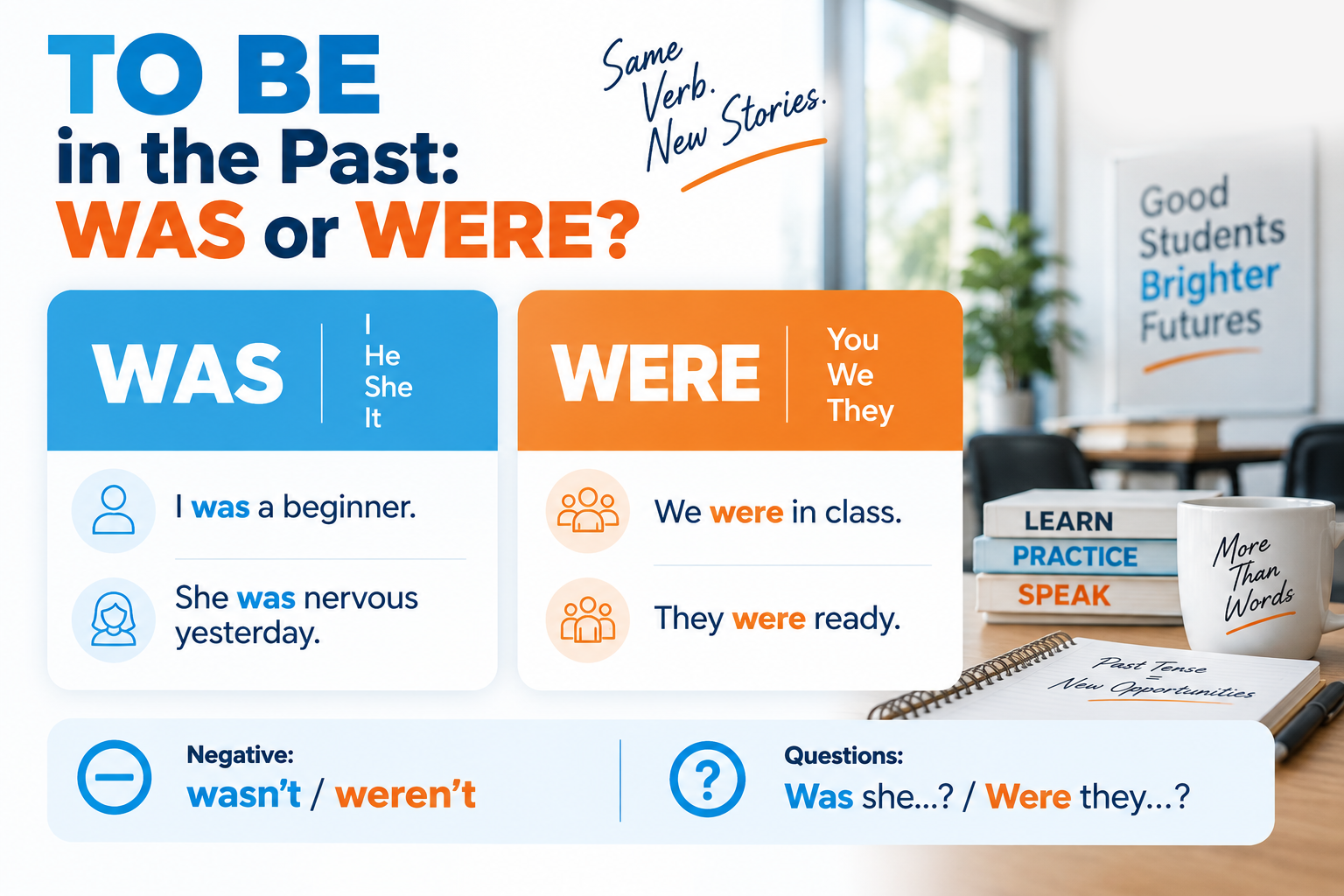
| Subject | Verb | Example |
|---|---|---|
| I | was | I was a beginner when I started at Lingua. |
| He / She / It | was | She was nervous on the first day. It was sunny yesterday. |
| You / We / They | were | You were in my class last semester. We were in Fort Lauderdale. They were late. |
Negative and Questions
| Negative | Example |
|---|---|
| I was not (wasn't) | Is she a teacher? |
| She was not (wasn't) | She wasn't at school yesterday. |
| They were not (weren't) | They weren't in Weston last week. |
| Question | Example |
|---|---|
| Was I...? | Was I wrong? |
| Was she...? | Was she your teacher in Doral? |
| Were they...? | Were they at the Fort Lauderdale campus? |
Short answers: Yes, I was. / No, I wasn't. / Yes, they were. / No, they weren't.
"To Be" in the Future Tense
For the future, use will be for all subjects. This is one of the few places in English where the verb form is the same for everyone.
| Subject | Future | Example |
|---|---|---|
| I | will be | I will be fluent next year. |
| She | will be | She will be a great speaker. |
| We | will be | We will be in the advanced class by December. |
| They | will be | They will be at the Weston campus tomorrow. |
Contraction: I'll be, She'll be, We'll be, They'll be.
Negative: will not be (contraction: won't be).
- I won't be late tomorrow.
- She won't be in class next week.
Questions: Will you be at the Fort Lauderdale campus on Monday?
"To Be" as a Helping Verb
Beyond describing states, "to be" is essential for building other tenses and structures in English:
Present Continuous (happening right now):
- I am studying English. (am + verb-ing)
- She is reading a book.
- They are waiting for the bus in Doral.
Past Continuous (was happening at a specific moment in the past):
- I was studying when you called.
- We were walking through Las Olas in Fort Lauderdale.
Passive Voice (when the subject receives the action):
- The letter was written by the teacher.
- The classes are taught by certified instructors.
- The program will be offered at all three campuses.
Understanding "to be" as a helping verb is critical because it appears in so many English structures. Once you master it, dozens of other grammar patterns become easier.
The 7 Most Common "To Be" Mistakes (and How to Fix Them)
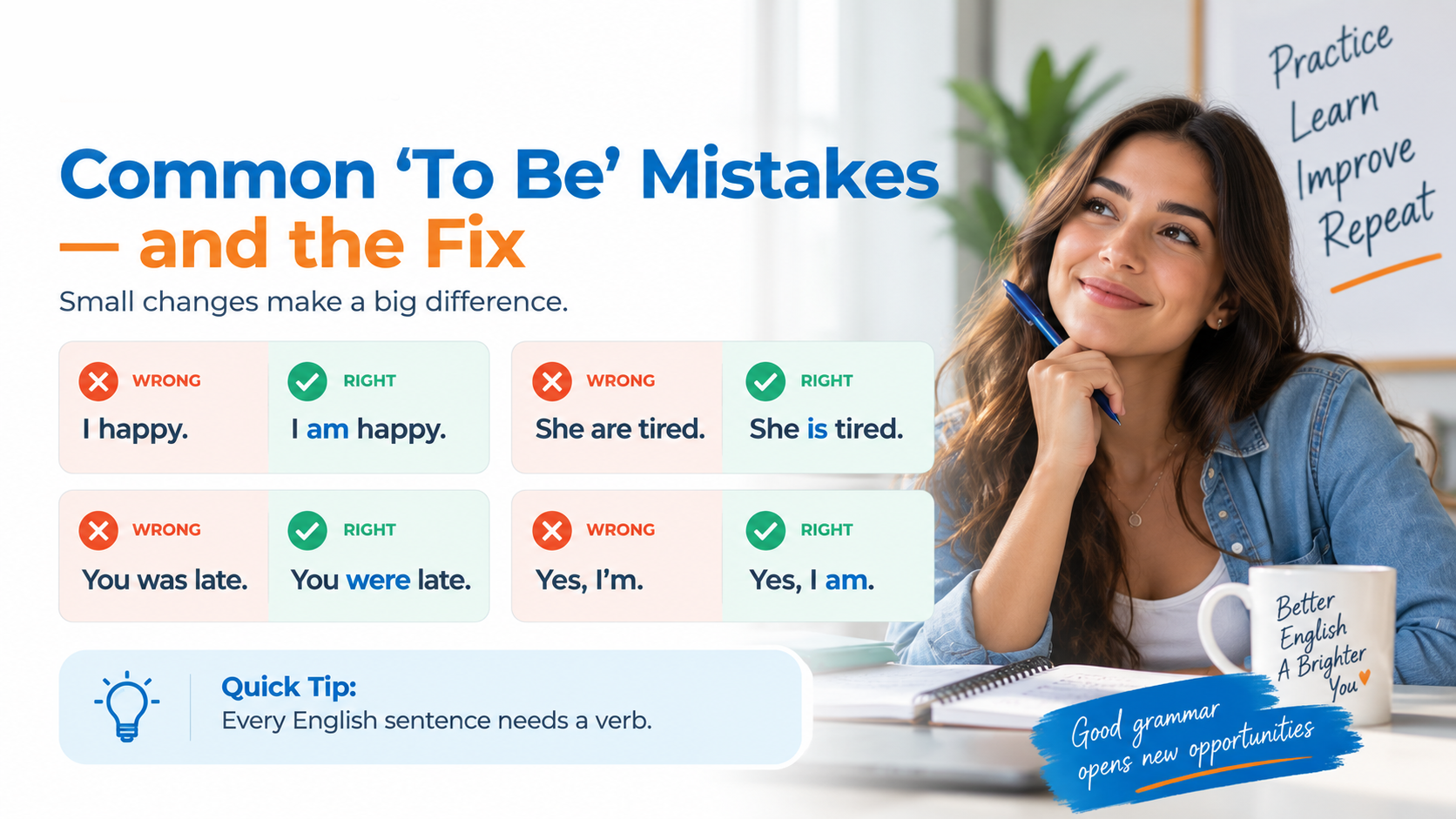
These are the errors our instructors at Lingua Language Center see most often — across students from dozens of language backgrounds. If you speak Spanish, Portuguese, Arabic, Mandarin, or French, you'll probably recognize a few.
Mistake 1: Forgetting "to be" entirely
Wrong: I happy. She tired. They students. Right: I am happy. She is tired. They are students.
Why it happens: In many languages (Russian, Arabic, Mandarin, Turkish), there is no equivalent of "to be" in the present tense. You can say "I happy" in Russian and it's grammatically correct. In English, you always need the verb.
Rule: In English, every sentence needs a verb. If there's no action verb, you need "to be."
Mistake 2: Using "to be" when you shouldn't
Wrong: I am agree with you. She is like chocolate. He is have a car. Right: I agree with you. She likes chocolate. He has a car.
Why it happens: Some learners add "to be" before every verb because they're used to their native language structure. But in English, "to be" is only used before adjectives, nouns, and locations — not before other verbs (except when forming continuous tenses or the passive voice).
Rule: Don't use "am/is/are" before action verbs. "I am study" is wrong. "I am studying" (continuous) or "I study" (simple) are correct.
Mistake 3: Confusing "it's" and "its"
Wrong: The school changed it's schedule. Its a beautiful day. Right: The school changed its schedule. It's a beautiful day.
Rule: It's = it is (or it has). Its = belonging to it. If you can replace it with "it is," use the apostrophe. Otherwise, don't.
Mistake 4: Confusing "they're," "their," and "there"
Wrong: Their happy. There going to class. They're books are on the table. Right: They're happy. They're going to class. Their books are on the table.
Rule: They're = they are. Their = belonging to them. There = a place.
Mistake 5: Confusing "your" and "you're"
Wrong: Your welcome. You're teacher is nice. Right: You're welcome. Your teacher is nice.
Rule: You're = you are. Your = belonging to you.
Mistake 6: Using "was" with "you/we/they"
Wrong: You was late. We was at school. They was happy. Right: You were late. We were at school. They were happy.
Why it happens: In casual speech, some native English speakers incorrectly say "you was" or "we was." But in standard English — the kind you need for academic, professional, and formal contexts — "was" is only for I/he/she/it.
Mistake 7: Answering questions incorrectly
Wrong: Are you a student? Yes, I'm. / Is she Brazilian? Yes, she's. Right: Are you a student? Yes, I am. / Is she Brazilian? Yes, she is.
Rule: In short affirmative answers, you never use a contraction. "Yes, I'm" is incorrect. "Yes, I am" is correct. However, in negative short answers, contractions are fine: "No, I'm not." / "No, she isn't."
Quick Reference Chart
| Tense | I | He/She/It | You/We/They |
|---|---|---|---|
| Present (+) | am | is | are |
| Present (-) | am not | is not (isn't) | are not (aren't) |
| Present (?) | Am I...? | Is he/she/it...? | Are you/we/they...? |
| Past (+) | was | was | were |
| Past (-) | was not (wasn't) | was not (wasn't) | were not (weren't) |
| Past (?) | Was I...? | Was he/she/it...? | Were you/we/they...? |
| Future (+) | will be | will be | will be |
| Future (-) | will not be (won't be) | will not be (won't be) | will not be (won't be) |
| Future (?) | Will I be...? | Will he/she/it be...? | Will you/we/they be...? |
Practice: Test Yourself
Fill in the blanks with the correct form of "to be":
- I ______ from Brazil. (present)
- She ______ at the Fort Lauderdale campus yesterday. (past)
- They ______ in the advanced class next month. (future)
- ______ you a student at Lingua? (present question)
- We ______ (not) late for class. (present negative)
- He ______ very tired after the TOEFL exam. (past)
- It ______ sunny in Doral today. (present)
- ______ they at the Weston campus last week? (past question)
- I ______ (not) ready for the test yesterday. (past negative)
- She ______ a great English speaker by the end of the program. (future)
Answers: 1. am 2. was 3. will be 4. Are 5. aren't (are not) 6. was 7. is 8. Were 9. wasn't (was not) 10. will be
Keep Learning at Lingua Language Center
The verb "to be" is just the beginning. At Lingua Language Center, our Intensive English Program takes you from foundational grammar like this all the way to advanced academic and professional English — using our communicative EnterTraining℠ methodology that gets you speaking, not just memorizing rules.
We've been teaching English in South Florida since 1998, and we offer programs for every level:
Programs: Intensive English (IEP) | Semi-intensive English (SIEP) | TOEFL Prep | Accent Reduction | Business English | Academic English | Foreign Languages (Spanish, Portuguese, French, Italian)
Locations: Fort Lauderdale | Doral, Miami | Weston | Online (Virtual Campus)
For international students: ACCET-accredited. SEVIS-certified. F-1 visa support with I-20 issuance. Start any Monday.
Ready to go beyond the basics? Contact us | (954) 577-9955
Frequently Asked Questions
What is the verb "to be" in English? "To be" is a verb that expresses existence, identity, or condition. Its present tense forms are "am" (I), "is" (he/she/it), and "are" (you/we/they). It's the most commonly used verb in English and is also used as a helping verb to form other tenses.
Why do I keep forgetting to use "to be" in English? If your native language is Russian, Arabic, Mandarin, Turkish, or another language that doesn't require a verb of being in the present tense, this is a common pattern. In English, every sentence requires a verb — so where there's no action verb, "to be" fills the role. Practice with structured exercises and real conversation helps make this automatic.
What is the difference between "it's" and "its"? "It's" is a contraction of "it is" or "it has." "Its" is a possessive pronoun meaning "belonging to it." If you can replace the word with "it is" and the sentence still makes sense, use "it's." Otherwise, use "its."
Where can I practice English grammar in South Florida? Lingua Language Center offers structured English programs — from beginner to advanced — at campuses in Fort Lauderdale, Doral (Miami), and Weston. Our programs include grammar, speaking, listening, reading, and writing with qualified instructors. Online classes are also available through our Virtual Campus.